
Repair or Replace Your AC? How to Run the Numbers in 10 Minutes
The $5,000 rule, real repair cost benchmarks, R-22 and R-410A refrigerant flags, heat pump trade-offs, and the contractor questions that separate honest advice from a sales pitch.
_1779220400871-BTmzb4Mz.jpg)
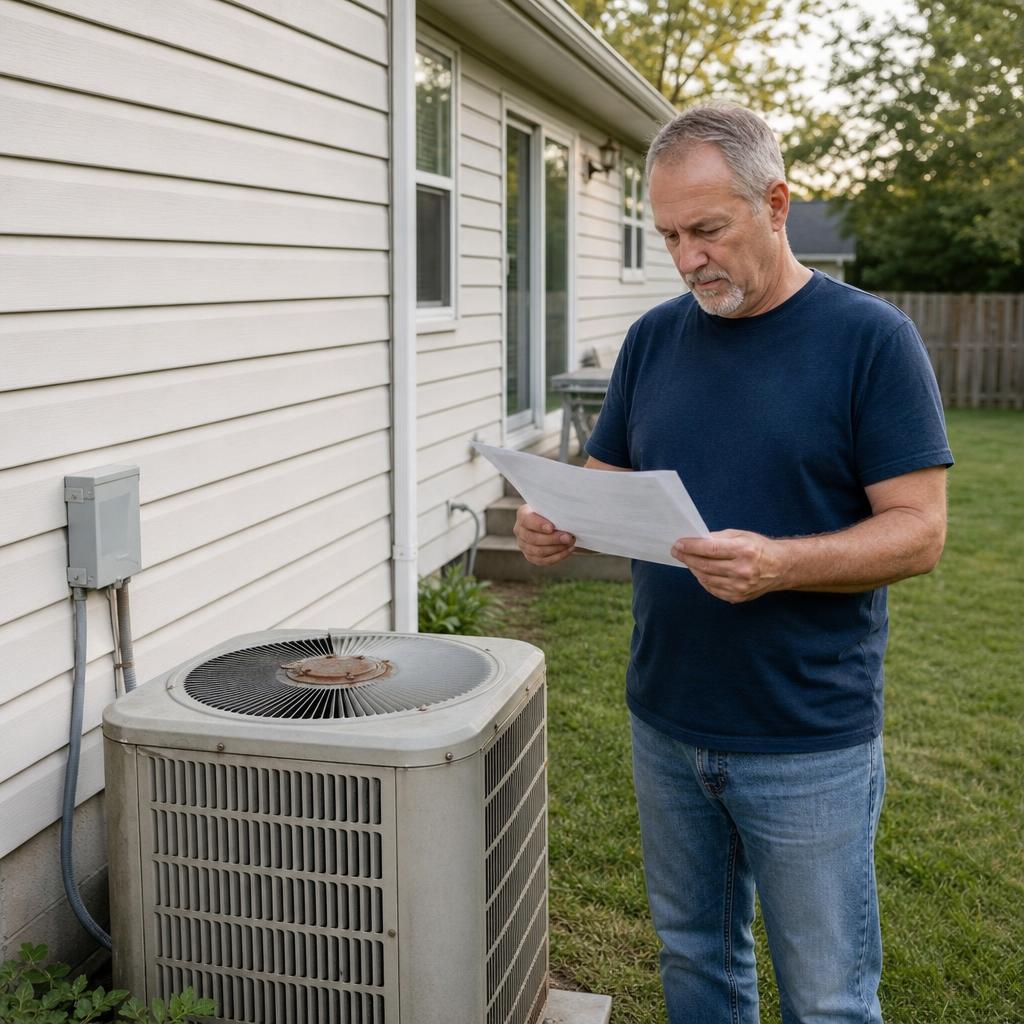
You just got a repair quote. Maybe it's $800 for a refrigerant leak and recharge. Maybe it's $2,400 for a new compressor. Before you sign anything, spend 10 minutes with this guide. The math is straightforward once you know your system's actual age.
Quick answer
Under 10 years old: repair almost anything. Over 15 years old: replace on any major failure. In between: multiply age by repair cost; over $5,000 means replace. If your system runs on R-22 refrigerant, replace it regardless of age. And get the actual manufacture date before you do any of this math, because the installation paperwork is often wrong.
Get the Real Age First
Age is the most important variable here, and it's the one most homeowners get wrong. The sticker inside your air handler shows an installation date. That's not the same as the manufacture date stamped into the serial number on the outdoor condenser, and that date is what actually matters.
Units sometimes sit in a distributor's warehouse for a year or two before they're installed. A system installed in 2015 could have been built in 2013. Two years doesn't sound like much, but it's the difference between a mid-life repair decision and a late-life one when the 5,000 rule is close to the line.
Use the age checker on this site to decode the serial number on the outdoor unit. It takes under a minute and returns the build date, not the installation date.
| System Age | General Guidance | Repair Threshold |
|---|---|---|
| Under 5 years | Likely still under parts warranty | Repair almost always. Check warranty first. |
| 5 to 10 years | Mid-life, parts available | Repair if under $800 to $1,000 |
| 10 to 15 years | Approaching end of average lifespan | Apply the 5,000 rule |
| 15 to 20 years | Past average lifespan, efficiency typically poor | Replace unless the fix is trivial (capacitor, contactor) |
| Over 20 years | Beyond expected lifespan | Replace; repair rarely makes sense |
Repair or replace?
Compare free quotes from licensed contractors near you.
The 5,000 Rule
Multiply the system's age in years by the repair quote in dollars. If the result clears $5,000, replacement usually makes more financial sense than the repair.
Think of it this way: the rule prices in how much lifespan you're buying with each repair. Paying $1,400 to fix a 14-year-old compressor might get you two more seasons. Paying $200 to replace a capacitor on the same unit gets you as many seasons as the system has left. Capacitors aren't the thing that kills a system.
| Age | Repair Quote | Age × Cost | Call |
|---|---|---|---|
| 6 years | $600 | 3,600 | Repair |
| 10 years | $800 | 8,000 | Lean toward replacing |
| 12 years | $350 | 4,200 | Repair (borderline) |
| 14 years | $1,400 | 19,600 | Replace |
| 16 years | $200 | 3,200 | Repair (it's a capacitor; see below) |
| 16 years | $1,800 | 28,800 | Replace |
The $200 capacitor row above technically crosses the threshold, but a capacitor is a $20 part and the most common wear item on any AC unit. Replacing the whole system over one is overkill. Use the rule as a starting point, not a verdict, and always factor in the failure type.
One more caveat: the rule assumes the rest of the system is otherwise sound. If you've had two or three separate failures in the past 24 months, that pattern matters more than any single repair calculation.
What Repairs Actually Cost
These are 2025 to 2026 national averages. A quote materially above the high end deserves a second opinion.
| Repair Type | Typical Cost Range | Worth Repairing on an Old System? |
|---|---|---|
| Capacitor replacement | $150 to $400 | Yes, almost always |
| Contactor replacement | $150 to $350 | Yes |
| Fan motor replacement | $300 to $700 | Yes, if nothing else is failing |
| Thermostat replacement | $150 to $500 | Yes |
| Refrigerant leak repair + recharge | $400 to $1,500 | Depends on age and leak location |
| Evaporator coil replacement | $700 to $2,000 | Only on systems under 10 years old |
| Condenser coil replacement | $900 to $2,500 | Rarely on older systems |
| Compressor replacement | $1,200 to $2,800 | Almost never. Replace the system instead. |
One diagnostic tip: if a contractor tells you the compressor has failed, ask them to show you the megohmmeter reading on the windings. A genuine compressor failure shows a shorted or open winding on a meter. No reading means a diagnosis by feel. What looks like a dead compressor is often a failed hard-start capacitor at a fraction of the price.
Repair or replace?
Compare free quotes from licensed contractors near you.
When Replacement Is the Clear Answer
Some situations make replacement the right call regardless of what the 5,000 formula says.
Your system uses R-22 refrigerant. R-22 was phased out of new production by the EPA on January 1, 2020. What's left is recycled stock, and prices have climbed to $80 to $150 per pound as of 2026 with nowhere to go but up. Any refrigerant leak repair on an R-22 system is expensive today and will be more expensive next year. Systems built before 2010 almost certainly run on R-22.
R-410A costs are rising too. As of January 1, 2025, manufacturers can no longer produce new equipment using R-410A. The refrigerant itself isn't banned from sale, so your 2015 system can still be serviced, but production is winding down and prices will follow the same trajectory R-22 did, just on a slower curve. It's not an emergency today. On an older system with a major failure, it's worth factoring in.
The compressor has failed. Replacement runs $1,200 to $2,800 in parts and labor. On a 12-plus-year-old system, that money almost always makes more sense applied toward a new unit. The compressor is the heart of the system; other components age alongside it.
The house never fully cools on hot days. Either the system has lost capacity to wear, or it was undersized from the start. A new properly sized unit fixes both. No repair addresses a capacity problem.
Multiple failures in the past two years. A pattern of breakdowns means cascading wear, not bad luck. Each repair buys less time than the last.
The Efficiency Math: What the Numbers Actually Show
Replacing an aging system does cut energy bills. The catch is that payback periods are longer than most contractors suggest, unless your old unit is genuinely very inefficient.
| Old System SEER | New System SEER2 | Annual Savings (est.)* | Payback on $6,000 install |
|---|---|---|---|
| SEER 10 | SEER2 16 | $225 to $300/year | 20 to 27 years |
| SEER 10 | SEER2 20 | $375 to $450/year | 13 to 16 years |
| SEER 13 | SEER2 16 | $100 to $150/year | 40 to 60 years |
*Estimated for a home with $750/year in cooling costs (e.g. $150/month over a 5-month season). Real savings vary by climate, runtime, and electricity rate.
The SEER 13 to SEER2 16 row is worth staring at. A 40-to-60-year payback is longer than the system will last. Efficiency savings alone don't justify the replacement. But when a major repair is already on the table, those savings tip the math further toward replacing. That's the right way to use these numbers.
Should You Consider a Heat Pump Instead?
If you're already replacing the AC, it's worth at least pricing a heat pump. Modern cold-climate models run effectively below 0°F and can handle both heating and cooling in one installed unit.
The upfront cost is higher, typically $9,000 to $18,000 installed depending on size and climate, but the IRA federal tax credit is $2,000 for a qualifying heat pump versus $600 for a qualifying central AC. If you were going to replace both the AC and furnace in the next few years anyway, doing them together as a heat pump makes the math more interesting.
In climates with mild winters and cheap natural gas, the payback often doesn't work. In the northeast, mid-Atlantic, or Pacific Northwest, where electricity rates are moderate and heating loads are real, it frequently does. Get a heat pump bid alongside your AC bid and compare them with the credits factored in.
What a New System Costs
These are 2025 to 2026 installed-cost national averages. Local labor rates and equipment availability move the number significantly in either direction.
| System Size | Standard Efficiency (SEER2 14 to 16) | High Efficiency (SEER2 18 to 22) |
|---|---|---|
| 2 tons | $3,500 to $5,500 | $5,500 to $8,000 |
| 2.5 tons | $3,800 to $6,000 | $6,000 to $9,000 |
| 3 tons | $4,200 to $6,500 | $6,500 to $10,000 |
| 3.5 tons | $4,800 to $7,500 | $7,500 to $11,000 |
| 4 tons | $5,500 to $8,500 | $8,500 to $13,000 |
| 5 tons | $6,500 to $10,000 | $10,000 to $15,000 |
On the IRA credits: a qualifying high-efficiency central AC gets a 30% tax credit capped at $600 per year. A qualifying heat pump gets 30% capped at $2,000. The credit resets each calendar year. If you're replacing multiple systems, it can be worth spreading them across two tax years to claim more of the credit. See the ENERGY STAR federal tax credit page for current qualifying equipment lists.
Questions to Ask the Contractor
Before you authorize anything, these questions separate honest advice from a sales pitch:
- How old is this system, and what's the expected remaining service life after this repair?
- Does this repair address the root cause, or is it patching a symptom?
- What refrigerant does this system use, and what is the current market price per pound?
- Are there other components likely to fail in the next 12 to 24 months?
- (If replacing) Will you do a Manual J load calculation? Can I see the printout?
- What's your labor warranty, and is the manufacturer warranty transferable if I sell?
Any contractor who pushes hard toward replacement on a 6-year-old system, or who won't consider replacement on a 20-year-old one, is worth a second opinion. The honest answer on a borderline system is "it could go either way," not a confident shove in one direction.
Choosing a Brand If You Replace
If replacement is the answer, brands with strong long-term track records include Carrier, Trane, Lennox, Goodman, and Rheem. For most homes, a mid-range SEER2 16 to 18 unit hits the right balance between upfront cost and long-term savings. Premium SEER2 20+ systems only pay back faster in hot climates with high electricity rates. In a mild climate, you'll likely never recover the premium.
If the system is running but just not cooling well, read our companion piece on why your AC is running but not cooling before you call anyone. Some of the most expensive repairs start with a diagnosis that skipped the basics.
The Bottom Line
Three numbers decide this: the system's real age, the repair quote, and what refrigerant it uses. Start with the manufacture date from the serial number, then run the age-times-cost math. Check the nameplate for R-22 or R-410A while you're at it. That's a 10-minute exercise that settles most cases.
When it doesn't settle it, the system is usually mid-life and the repair is mid-sized. Get a second opinion on both the repair and a replacement bid. The cost of that call is nothing compared to a $6,000 decision made in 20 minutes.