
What Size AC Do I Need? A Complete Sizing Guide
Not sure what size AC you need? Learn the BTU rules of thumb for your climate, what adjusts the number up or down, and the one thing to insist on before any install.
_1779220400871-BTmzb4Mz.jpg)
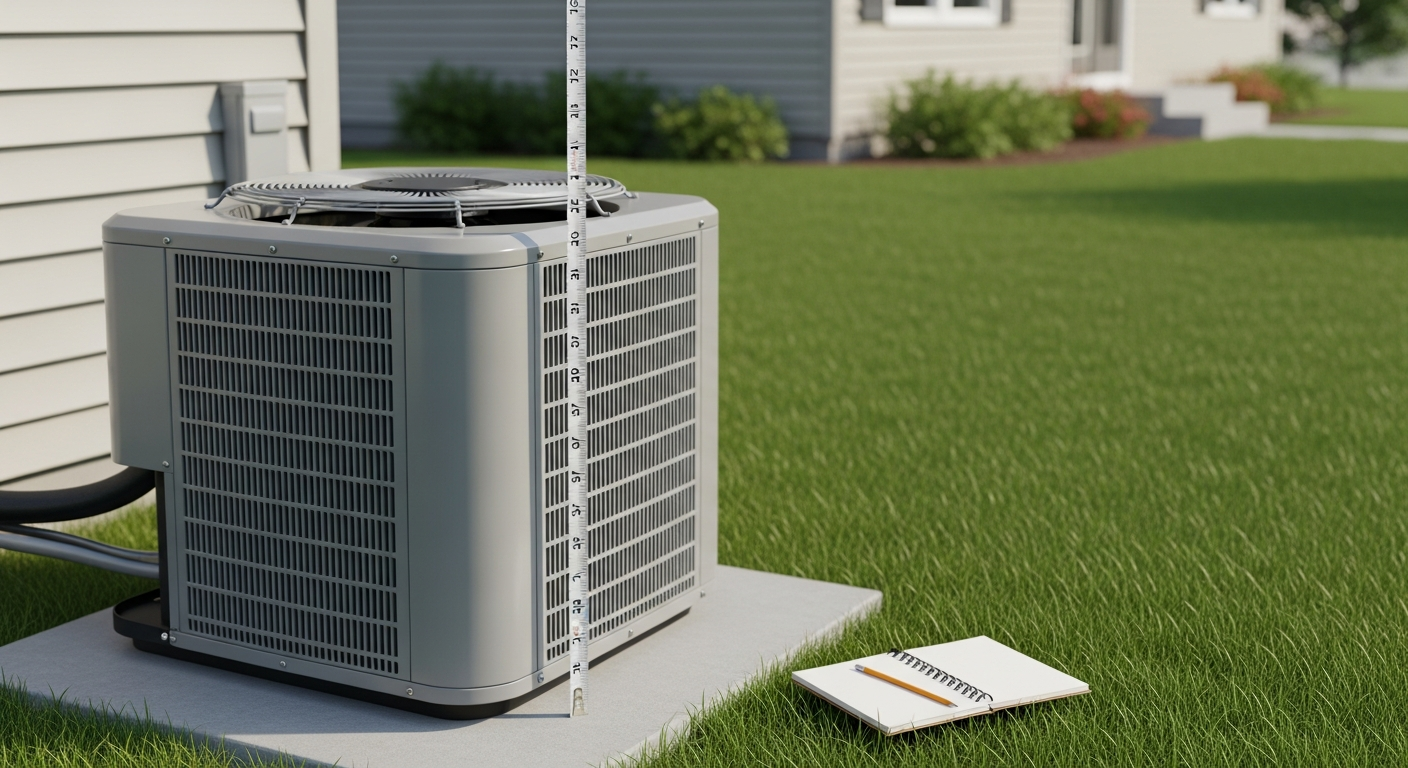
A reader in Phoenix emailed me last summer. His contractor had quoted a 5-ton unit for a 1,900 square foot house. He pulled out an old utility bill, ran a rough calculation, and realized his existing 3-ton system had kept the house at 75 even on 115-degree days. The contractor was upsizing by almost 70 percent. Had he installed it, the house would have felt damp all summer and the compressor would have burned out years early from short cycling.
AC sizing is the most expensive single call in an installation, and contractors get it wrong more often than anything else. Below is how to size correctly, why bigger is not better, and what to insist on before you sign.
Quick answer
Start with 20 to 25 BTU per square foot of conditioned space, then adjust for climate and house quality. A typical well-insulated 2,000 sq ft home in a moderate climate needs 3 to 3.5 tons (36,000 to 42,000 BTU). Never authorize a new install without a printed Manual J load calculation. Oversizing is the most common installer mistake and the most expensive one to live with.
What "Tonnage" Actually Means
One "ton" of AC is 12,000 BTU per hour of cooling capacity. The term comes from how much heat it takes to melt one ton of ice over 24 hours. Residential central ACs come in half-ton increments:
- 1.5 tons = 18,000 BTU
- 2 tons = 24,000 BTU
- 2.5 tons = 30,000 BTU
- 3 tons = 36,000 BTU
- 3.5 tons = 42,000 BTU
- 4 tons = 48,000 BTU
- 5 tons = 60,000 BTU
Repair or replace?
Compare free quotes from licensed contractors near you.
How Many BTU Per Square Foot Does Your Home Need?
The classic rule is 20 to 25 BTU per square foot. A 2,000 sq ft home in a moderate climate needs roughly 40,000 to 50,000 BTU, which lands at 3.5 to 4 tons. Use the table below as a starting point, then adjust for climate and house quality in the following sections.
| Square Footage | BTU Range | Tons (moderate climate) |
|---|---|---|
| 600 to 1,000 | 14,000 to 24,000 | 1.5 to 2 tons |
| 1,000 to 1,500 | 22,000 to 30,000 | 2 to 2.5 tons |
| 1,500 to 2,000 | 30,000 to 42,000 | 2.5 to 3.5 tons |
| 2,000 to 2,500 | 40,000 to 50,000 | 3.5 to 4 tons |
| 2,500 to 3,000 | 48,000 to 60,000 | 4 to 5 tons |
| 3,000 to 3,500 | 55,000 to 65,000 | 4.5 to 5 tons |
How Does Your Climate Change the Tonnage?
A 2,000 sq ft home in Minneapolis and a 2,000 sq ft home in Houston have very different cooling loads. Use the table below to find the right BTU per square foot range for your region. If you want to look up your official climate zone, the DOE/IECC climate zone map is the reference contractors and energy codes use.
| Climate | BTU per Sq Ft | Example Cities |
|---|---|---|
| Cool | 18 to 20 | Seattle, Minneapolis, Chicago |
| Moderate | 20 to 25 | Denver, Kansas City, Sacramento |
| Warm | 25 to 30 | Atlanta, Charlotte, Dallas |
| Hot and Humid | 28 to 33 | Houston, New Orleans, Miami |
| Hot and Dry | 25 to 30 | Phoenix, Las Vegas, Tucson |
Worked example: 2,000 sq ft home in Atlanta. 2,000 x 27 BTU/sq ft = 54,000 BTU = 4.5 tons. The same house in Denver: 2,000 x 22 = 44,000 BTU = 3.5 tons. Same square footage, one full ton of difference, just from location.
Which House Characteristics Add or Subtract BTUs?
Rules of thumb assume an "average" house: 8-foot ceilings, code-minimum insulation, normal window-to-wall ratios, average air leakage. Adjust from the baseline if your house differs, and most houses don't match on at least two of these.
| House Characteristic | Adjustment |
|---|---|
| 10+ foot ceilings | +10 to 15% |
| Lots of west or south-facing glass | +10% |
| Heavy shade from mature trees | -10% |
| Old or single-pane windows | +10 to 15% |
| Recently insulated and air-sealed | -10 to 20% |
| 5 or more occupants regularly home | +5 to 10% |
| Open kitchen connected to living area | +5% |
Repair or replace?
Compare free quotes from licensed contractors near you.
What Is a Manual J Load Calculation, and Why You Need One
Rules of thumb get you within one ton. A proper ACCA Manual J load calculation gets you within 5,000 BTU. It accounts for square footage of each room, ceiling height, R-values of walls and attic, window U-factor and solar heat gain coefficient by orientation, air infiltration rate, duct location and leakage, occupancy, and your specific local design temperatures from ASHRAE data.
A real Manual J takes 30 to 60 minutes on a laptop with software like Wrightsoft or CoolCalc, and should be included in any full install quote at no extra charge. If a contractor wants to charge you separately for it, that is a negotiating point, not a given.
The one question to ask every contractor: "Will you perform a Manual J, and can I have the printout?" If they say "I'll just match what's there" or "I can tell by looking," find someone else. Replacing a 25-year-old system like-for-like perpetuates whatever sizing mistake the original installer made. I have never regretted asking for that printout, and I have seen quotes drop by an entire ton (and several thousand dollars) when contractors realized I was checking their math.
One legitimate exception: If your existing system has run well for 15 or more years and nothing has changed (no additions, no window replacements, no insulation upgrades), that track record is real data. The Manual J should confirm the existing size, but it is not likely to recommend something dramatically different.
Why Oversizing Your AC Is Worse Than Going Too Small
Most contractors err high "just to be safe." That instinct is the wrong one. An oversized AC causes:
- Short cycling. The system hits setpoint in 5 to 8 minutes and shuts off, then restarts 10 minutes later. Each startup is the hardest moment in a compressor's life. Constant cycling shortens lifespan from 18 years toward 10.
- Poor humidity control. Dehumidification happens after about 10 minutes of continuous runtime, once the indoor coil cools enough to condense water. Short cycles skip that window entirely. The house feels clammy at 72 degrees instead of comfortable at 76.
- Uneven temperatures. The system cools the room with the thermostat and shuts off before conditioned air reaches far rooms.
- Higher cost, upfront and ongoing. A 5-ton install can run $2,000 more than a 3-ton, and the larger unit draws more current every time it starts.
An undersized AC runs continuously on hot days and may not keep up during a heat wave. That is uncomfortable. But it removes humidity well, runs quietly, and lasts a normal lifespan. Given a choice between a half-ton over and a half-ton under, lean slightly under.
Does Your Ductwork Match the New System?
A correctly sized AC paired with undersized or leaky ductwork still performs badly. ENERGY STAR estimates the average home loses 20 to 30 percent of conditioned air through duct leaks before it reaches the rooms. If your duct system is original to a home built before 2000, or if you know it runs through an unconditioned attic without insulation on the exterior, ask the contractor to evaluate it as part of the install.
Duct sealing typically costs $300 to $900. Replacing undersized duct sections runs $500 to $2,000 depending on access. In some cases, fixing the ducts is cheaper than upsizing the equipment and produces better results. See our guide on why AC blows warm air for more on how duct problems show up as comfort complaints.
Real-World Sizing Examples
| Home | Climate | Recommended Size |
|---|---|---|
| 1,200 sq ft ranch, decent insulation | Charlotte (warm) | 2 to 2.5 tons |
| 1,800 sq ft 2-story, average insulation | Denver (moderate) | 3 tons |
| 2,400 sq ft, 10 ft ceilings, west-facing | Houston (hot and humid) | 4.5 to 5 tons |
| 3,000 sq ft, recently insulated and sealed | Atlanta (warm) | 3.5 to 4 tons |
| 1,500 sq ft older home, single-pane windows | Phoenix (hot and dry) | 3 tons |
How to Tell If Your Current AC Is the Wrong Size
Many people searching for AC sizing are not shopping for new equipment; they are trying to explain why the system they have does not feel right. Both problems have recognizable patterns.
Signs your system is oversized:
- It runs in short bursts of 5 to 8 minutes, shuts off, then starts again within 10 to 15 minutes all day
- The house hits the temperature setpoint but still feels sticky or humid
- Some rooms are too cold while others never cool down (the thermostat is satisfied before air reaches far rooms)
- The system seems new or well-maintained but energy bills are still high
Signs your system is undersized:
- It runs continuously during hot afternoons without ever reaching setpoint
- The house stays 3 to 5 degrees above the thermostat setting from 2 to 7 p.m.
- It struggled from its first summer, not just after years of use
If the system short cycles, humidity is usually the complaint. If it runs all day without hitting setpoint on days under 95 degrees, undersizing is likely. On days above 95 to 100 degrees, even a correctly sized system may run continuously. That is not undersizing, that is physics. See our AC warm air troubleshooting guide for how to separate the two.
How to Find What Tonnage Your Current System Is
Find the model number on the outdoor unit's data plate. Look for a two- or three-digit number divisible by 6 or 12, typically embedded in the middle of the model number:
- 18 or 019 = 1.5 tons
- 24 or 024 = 2 tons
- 30 or 030 = 2.5 tons
- 36 or 036 = 3 tons
- 42 or 042 = 3.5 tons
- 48 or 048 = 4 tons
- 60 or 060 = 5 tons
If your current system has held the house comfortable through multiple summers, that size is a strong reference point for the replacement, and a Manual J should confirm it. Run the model and serial through our free HVAC age tool to confirm the manufacture year at the same time.
Single-Stage, Two-Stage, or Variable-Speed: Does It Change the Size?
Variable-speed systems run the compressor anywhere from 25 to 100 percent capacity depending on conditions, rather than full-on or full-off. That means longer, quieter runtimes, better humidity control, and better temperature consistency room to room. They are also more forgiving of slight oversizing, because a half-ton over on a variable-speed system can just run at 80 percent instead of 100. On a single-stage system, that same half-ton over produces constant short cycling.
Variable-speed systems from Carrier (Infinity series), Lennox (Signature series), and Trane (XV series) typically cost $3,000 to $5,000 more than entry-level single-stage equipment installed. Two-stage is a middle ground: two output levels (usually 65 and 100 percent), better humidity control than single-stage, and roughly $500 to $1,000 less than full variable. Both still need correct sizing; the tolerance for error is just wider.
Heat pump note: Sizing principles are the same for heat pumps on the cooling side. The difference is that your installer must also size for heating and verify the system can handle your winter design temperature. In climates that get below 20 degrees F regularly, the heating load often drives the size selection, not cooling.
What to Expect to Pay by System Size
Equipment and labor costs vary by region, brand, and efficiency rating, but the ranges below give a realistic baseline for a standard split-system AC replacement in 2025 to 2026. These are total installed costs including equipment, refrigerant, electrical connections, and standard labor. They do not include ductwork repairs or permits, which are additional.
| System Size | Installed Cost Range | Notes |
|---|---|---|
| 1.5 tons | $2,500 to $4,500 | Small homes, condos |
| 2 tons | $2,800 to $5,000 | Most common small-home size |
| 2.5 tons | $3,000 to $5,500 | 1,000 to 1,500 sq ft in most climates |
| 3 tons | $3,200 to $6,000 | Most common residential size |
| 3.5 tons | $3,500 to $6,500 | 1,500 to 2,000 sq ft in warm climates |
| 4 tons | $3,800 to $7,500 | Larger homes, hot climates |
| 5 tons | $4,500 to $9,000 | Large homes; confirm sizing carefully |
Each half-ton step up typically adds $300 to $700 in equipment cost. High-efficiency systems (18+ SEER2) and variable-speed equipment add $2,000 to $5,000 on top of these ranges. For a more detailed estimate, use our HVAC replacement calculator.
Before You Sign: The Short Version
That contractor in Phoenix was not trying to defraud anyone. He was just doing what most contractors do: replace with whatever fits, maybe go a little bigger for margin. The homeowner who caught it did three things: checked the existing system's track record, ran a rough load calculation, and asked a question. The quote dropped by two tons and several thousand dollars.
Before you authorize any new install:
- Run the square footage x BTU/sqft math for your climate as a sanity check.
- Adjust for ceiling height, windows, shading, and insulation.
- Compare the result to your existing system's real-world performance.
- Ask for the Manual J printout. If they will not provide one, find someone who will.
For a full cost breakdown, use our HVAC replacement calculator. If you are on the fence between repairing the existing system and replacing it, read our repair vs replace guide before committing. Brand-specific lifespan and pricing data is on our Carrier, Trane, Lennox, Goodman, and Rheem brand pages.