
Heat Pump vs Gas Furnace: Which Is Right for Your Home?
Heat pumps and gas furnaces heat homes in completely different ways. Compare upfront cost, operating cost, efficiency, climate fit, and lifespan to choose.
_1779220400871-BTmzb4Mz.jpg)
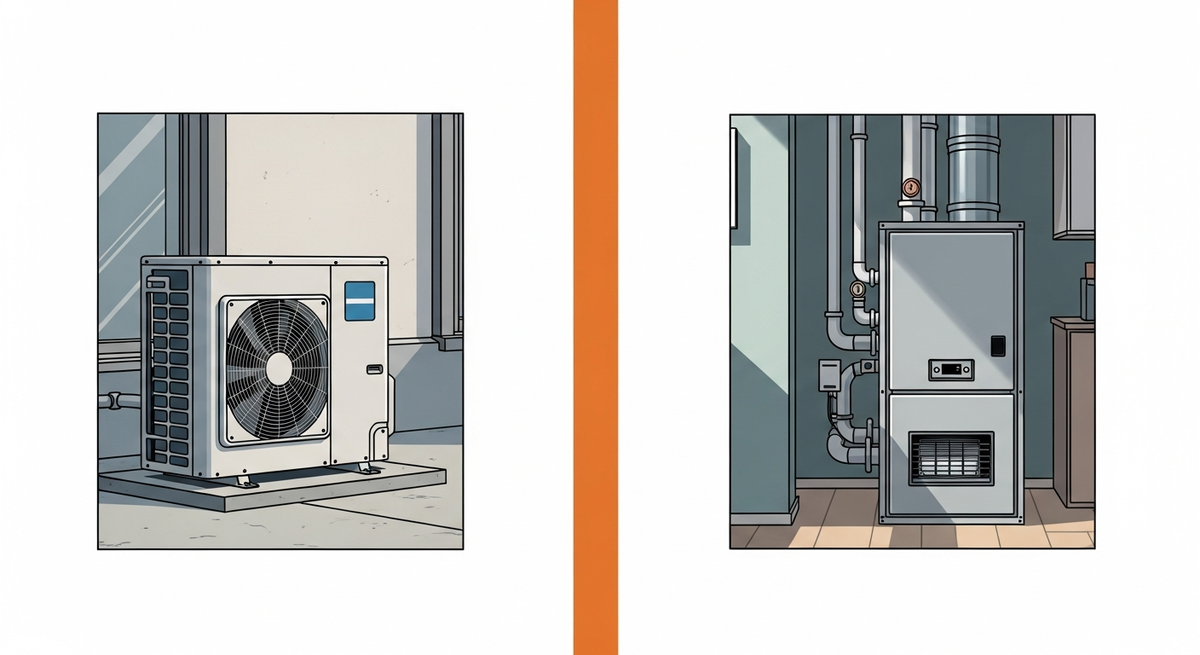
When a furnace or air conditioner finally gives out, most homeowners assume they will replace it with the same kind of equipment. But the heating choice is wider than it used to be. Heat pumps have improved dramatically, and in many homes they now make more sense than a traditional gas furnace. In others, gas is still the better call. The right answer depends on your climate, your energy prices, and how your home is set up today.
This guide walks through how each system works, what they cost to buy and run, how long they last, and which one fits which situation. By the end you will know which direction to lean before you call for quotes.
Quick answer
A heat pump is usually the better choice in mild to moderate climates, where electricity is reasonably priced, and when you want one system for both heating and cooling. A gas furnace wins in very cold climates, where natural gas is cheap, or when you already have a working AC and just need heat. In cold regions, a dual-fuel system that pairs both often beats either one alone.
How Each System Heats Your Home
The core difference is simple. A gas furnace makes heat by burning fuel. A heat pump moves heat that already exists.
A gas furnace burns natural gas or propane in a sealed combustion chamber. The hot combustion gases pass through a heat exchanger, the blower pushes household air across that hot metal, and warm air travels through your ducts. It is a proven, powerful way to make heat, and it produces very warm air quickly even on the coldest day.
A heat pump looks like a central air conditioner and works on the same principle, except it runs in both directions. In summer it pulls heat out of your house and dumps it outside, exactly like an AC. In winter it reverses, pulling heat out of the outdoor air, even cold air, and bringing it inside. Because it moves heat rather than generating it, a heat pump can deliver more energy as heat than it consumes as electricity. The U.S. Department of Energy notes this is why heat pumps can be so efficient.
Repair or replace?
Compare free quotes from licensed contractors near you.
Head to Head Comparison
Here is how the two stack up across the factors that matter most to a homeowner.
| Factor | Heat Pump | Gas Furnace |
|---|---|---|
| Heating and cooling | Both, one system | Heating only, needs separate AC |
| Best climate | Mild to moderate, cold with backup | Cold and very cold |
| Operating cost | Low where electricity is reasonable | Low where gas is cheap |
| Upfront cost | $4,500 to $10,000 typical | $3,000 to $6,500 furnace only |
| Typical lifespan | 12 to 15 years | 15 to 20 years |
| Air temperature at vents | Warm, gentle, longer cycles | Hot, fast bursts |
| On-site emissions | None, all electric | Burns fuel on site |
What They Cost to Run
Operating cost is where this decision is usually won or lost, and it comes down to local energy prices. A heat pump is rated by its HSPF2 efficiency, and a modern unit delivers roughly two and a half to four units of heat per unit of electricity in moderate weather. A gas furnace is rated by AFUE, the percentage of fuel it turns into usable heat. A high-efficiency furnace runs 90 to 98 percent AFUE.
The catch is that electricity and gas are priced differently in every region. Where electricity is cheap and gas is expensive, the heat pump wins easily. Where natural gas is cheap and electricity is costly, a gas furnace can be cheaper during the coldest stretch. There is also a temperature effect: a heat pump's efficiency drops as the outdoor air gets colder, so its running-cost advantage shrinks on the coldest days.
| Your Situation | Likely Cheaper to Run |
|---|---|
| Mild winters, moderate electricity rates | Heat pump |
| Cheap natural gas, expensive electricity | Gas furnace |
| No gas line, all-electric home | Heat pump |
| Very cold winters, low gas prices | Gas furnace or dual fuel |
Repair or replace?
Compare free quotes from licensed contractors near you.
The Dual-Fuel Option
You do not always have to choose one or the other. A dual-fuel or hybrid system pairs a heat pump with a gas furnace in the same setup. The heat pump handles heating efficiently during mild and moderate weather, and when the temperature drops below a set point where gas becomes cheaper or the heat pump struggles, the system automatically switches to the furnace.
For homeowners in cold climates who already have natural gas, dual fuel often delivers the lowest year-round operating cost. You get the efficiency of the heat pump most of the season and the brute-force warmth of gas on the coldest days. The downside is higher upfront cost, since you are buying both pieces of equipment.
Climate Is the Deciding Factor
If you take one thing from this guide, let it be this: match the system to your climate.
- Warm and mild regions: A heat pump is almost always the smart pick. It cools efficiently in summer and heats easily through the mild winter, all from one system.
- Moderate, mixed climates: A modern heat pump works well here, sometimes with modest backup heat for the occasional cold snap. This is where heat pumps have made the biggest gains.
- Cold and very cold regions: A high-efficiency gas furnace, or a dual-fuel system, usually delivers the most reliable comfort and the lowest cost on the coldest days. Cold-climate heat pumps are improving fast, so get a load calculation before ruling one out.
Tax Credits and Rebates
Incentives can shift the math significantly. As of 2026, the federal tax credit covers up to 30 percent of the cost of a qualifying heat pump, capped at $2,000 per year, while qualifying high-efficiency gas furnaces can earn a smaller credit. Check the ENERGY STAR federal tax credit page for current limits, and look into state and utility rebates, which often stack on top and can be generous for heat pumps.
How to Make the Call
Before you commit, work through these questions:
- How cold does it actually get where you live, and for how many weeks?
- What do you pay per unit of electricity versus natural gas?
- Do you already have a working air conditioner, or do you need cooling too?
- Is there a gas line to the house, or is it all electric?
- How old is your current equipment, and is one piece about to fail anyway?
If your air conditioner and furnace are both aging, replacing both with a single heat pump can be the cleanest and most cost-effective move. If only one is failing and the other has years left, that often points you toward a like-for-like replacement instead.
Check What You Have First
Before you spend a dollar, find out how old your current system really is. Use our free HVAC age lookup tool to decode the serial number and get the true manufacture date. If your existing furnace or AC still has years of life, you may have time to plan. If it is past its prime, read our guide on whether to repair or replace and run the numbers in our replacement cost calculator.
When you are ready to compare equipment, you can look up reliability and specs by brand, including Carrier, Trane, Goodman, Lennox, and Rheem, each of which makes both heat pumps and gas furnaces.
The Bottom Line
There is no single winner. A heat pump is efficient, does both heating and cooling, and shines in mild to moderate climates with reasonable electricity prices. A gas furnace delivers powerful, dependable heat and wins where it gets very cold or gas is cheap. And a dual-fuel system lets you stop choosing. Start with your climate and your energy bills, factor in the incentives, and the right answer for your home becomes clear.