
How Long Does an HVAC System Last? Lifespan by Type
Real lifespan numbers for central AC, heat pumps, furnaces, and mini splits, plus the factors that add or subtract years and the signs yours is near the end.
_1779220400871-BTmzb4Mz.jpg)
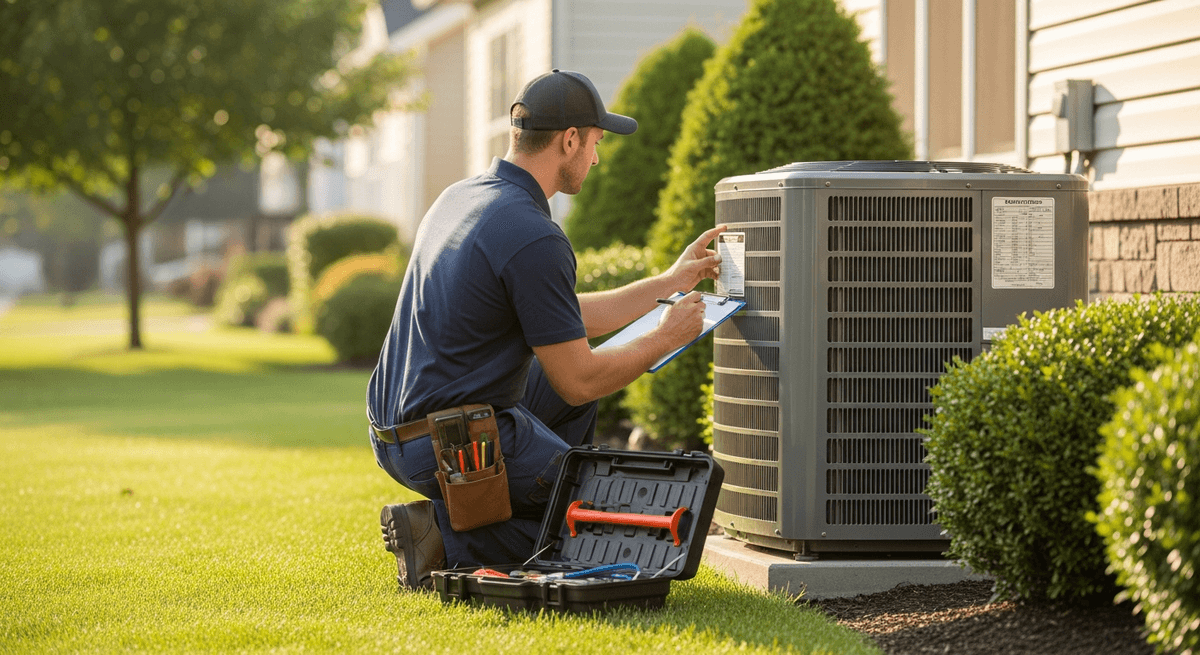
Every week our age checker decodes serial numbers for units built in the 1990s that are still running, and units built in 2015 that have already been replaced. Same brands, same climates, wildly different outcomes. So when someone asks how long an HVAC system lasts, the honest answer is a range, and where your system falls inside that range depends on a handful of factors you can actually see and control.
This guide gives you the real numbers by equipment type, explains why identical units age so differently, and shows you how to figure out where your own system sits on the clock.
Quick answer
Central air conditioners last 15 to 20 years, heat pumps 12 to 18, gas furnaces 15 to 25, and ductless mini splits 15 to 20. Maintenance, install quality, climate, and runtime move any of these numbers by five years or more in either direction. Start by finding your unit's actual manufacture date with our free serial number lookup, because the installation date is often wrong.
Lifespan by System Type
These ranges combine ASHRAE's published median service life data with manufacturer guidance from Carrier, Trane, and the U.S. Department of Energy. The median matters: half of all units fail before it, half last longer.
| System Type | Typical Lifespan | What Usually Fails First |
|---|---|---|
| Central air conditioner | 15 to 20 years | Compressor, condenser coil leaks |
| Heat pump | 12 to 18 years | Compressor (double the run hours) |
| Gas furnace, standard (80% AFUE) | 15 to 20 years | Heat exchanger cracks, blower motor |
| Gas furnace, condensing (90%+ AFUE) | 20 to 25 years | Secondary heat exchanger, inducer motor |
| Electric furnace / air handler | 20 to 30 years | Blower motor, control board |
| Ductless mini split | 15 to 20 years | Circuit boards, refrigerant leaks at flares |
| Window unit | 8 to 10 years | Compressor, corroded coils |
| Oil furnace | 15 to 25 years | Heat exchanger, burner assembly |
Repair or replace?
Compare free quotes from licensed contractors near you.
Step One: Find Out How Old Yours Actually Is
None of the numbers above mean anything until you know your system's real age, and most homeowners get this wrong in a predictable way. The sticker a contractor left on the unit shows the installation date. The serial number on the data plate encodes the manufacture date. Those can differ by a year or more, because equipment sits in distributor warehouses, and because plenty of "new" installs in the 2000s used older stock.
Grab the model and serial number from the data plate on your outdoor unit or furnace cabinet and run it through our free HVAC age lookup. It decodes the serial formats for more than 50 brands and gives you the actual build date in seconds. If the plate is faded, take a photo and use the label scanner on the same page.
Why Identical Units Age So Differently
ASHRAE's 15-year median for a split-system AC hides a huge spread. Here are the factors that move the number most, roughly in order of impact.
Runtime and climate
A compressor is a machine with a finite number of operating hours in it. An AC in Phoenix that runs eight months a year ages roughly twice as fast in calendar terms as the same unit in Minneapolis that runs three. This is also why heat pumps trail air conditioners: they work the cooling season and the heating season. If you live somewhere with 3,000+ cooling hours a year, read the lifespan table a notch shorter.
Maintenance, especially the filter
The most common cause of early HVAC death is not a bad part, it is airflow starvation from a clogged filter. Low airflow overheats blower motors, freezes evaporator coils, and pushes head pressures up until the compressor gives out years early. A filter change every 1 to 3 months and an annual coil cleaning are the difference between the low end and the high end of every range in the table. Our seasonal maintenance checklist covers the full routine.
Install quality and sizing
An oversized AC cools the house fast, shuts off, and restarts a few minutes later. That short cycling multiplies the number of compressor starts, which is when most wear happens, and it never runs long enough to dehumidify properly. Systems sized by an actual load calculation instead of a rule of thumb last visibly longer. If you are replacing equipment, our guide on what size AC you need explains how to check the contractor's math.
Location and corrosion
Salt air is brutal on condenser coils. Standard outdoor units within a mile or two of the coast can corrode out in well under 10 years, which is why coastal installs should use coated coils and get a fresh-water rinse a few times a season. Units sitting in dryer vent exhaust, under constant roof runoff, or buried in shrubs suffer a slower version of the same fate.
Refrigerant era
Age interacts with repair economics. If your AC or heat pump was built before 2010, it likely runs R-22 refrigerant, which is no longer produced and is expensive to buy reclaimed. A repairable leak on an R-22 system often costs enough to make replacement the smarter move, which effectively shortens the practical lifespan of that whole generation of equipment.
Furnaces: The Heat Exchanger Is the Clock
A furnace lasts as long as its heat exchanger, the metal chamber that keeps combustion gases separated from the air you breathe. Motors, boards, and igniters are all replaceable at reasonable cost. A cracked heat exchanger is not: on a furnace past 12 to 15 years, the repair usually costs more than half a new furnace, and a crack can allow carbon monoxide into the airstream, so it cannot be deferred.
Efficiency tier matters too. Standard 80% AFUE furnaces typically run 15 to 20 years. Condensing furnaces at 90%+ AFUE are built with stainless secondary heat exchangers and commonly reach 20 to 25 when the condensate drainage is kept clean. If your furnace is making new noises on startup, our guide to furnace sounds and what they mean can help you tell a $20 fix from an end-of-life symptom.
Signs Your System Is Near the End
- Repairs are clustering. One repair in a decade is normal. Two in two years on a 14-year-old system is the pattern of a machine wearing out as a whole.
- Energy bills are climbing without rate changes. Compressors and heat exchangers lose efficiency as they wear, so the same comfort costs more each season.
- It runs longer but does less. Longer cycles, rooms that never quite get comfortable, and humidity that hangs around are all signs of declining capacity.
- The refrigerant or parts are obsolete. When a technician has to hunt for reclaimed refrigerant or a discontinued board, every future repair gets more expensive.
If your system is showing these signs, run the numbers before the next breakdown does it for you. Our repair-or-replace guide walks through the 5,000 rule and the efficiency math step by step, and it works for furnaces as well as ACs.
Does Brand Change the Lifespan?
Less than people think. The spread between a well-installed budget brand and a poorly installed premium brand overwhelmingly favors the budget unit. That said, build quality is real at the component level, and some brands have decades-long track records: see our comparison of Carrier vs Trane for how the two biggest names stack up. What matters more than the badge is that the installer sized the system correctly, pulled a proper vacuum on the line set, and that you can get parts locally.
The U.S. Department of Energy keeps solid plain-language guidance on cooling equipment selection if you end up shopping.
How to Buy the High End of the Range
- Change filters every 1 to 3 months. Cheapest insurance in home ownership.
- Get a professional tune-up yearly. Cooling in spring, heating in fall. Refrigerant charge and combustion checks catch slow killers early.
- Keep the outdoor unit clear. Two feet of clearance, coils rinsed, no dryer vent blowing on it.
- Fix airflow problems promptly. Frozen coils and overheating motors are symptoms; the cause is almost always airflow.
- Register the warranty. Most brands cut parts coverage roughly in half if you skip the 60 to 90 day registration window after install.
The Bottom Line
Plan around 15 to 20 years for a central AC, 12 to 18 for a heat pump, and 15 to 25 for a gas furnace depending on its efficiency tier. Your maintenance habits and the quality of the original install decide which end of the range you get. Start with the one fact that anchors everything else: the actual manufacture date. Decode your serial number, see how many years are realistically left, and you can budget for replacement on your schedule instead of the machine's.