
Mini-Split vs Central Air: Which One Is Right for Your Home?
Side-by-side cost breakdown, efficiency numbers, and the specific situations where each system wins. Plus what most mini-split sales pitches leave out about resale and aesthetics.
_1779220400871-BTmzb4Mz.jpg)
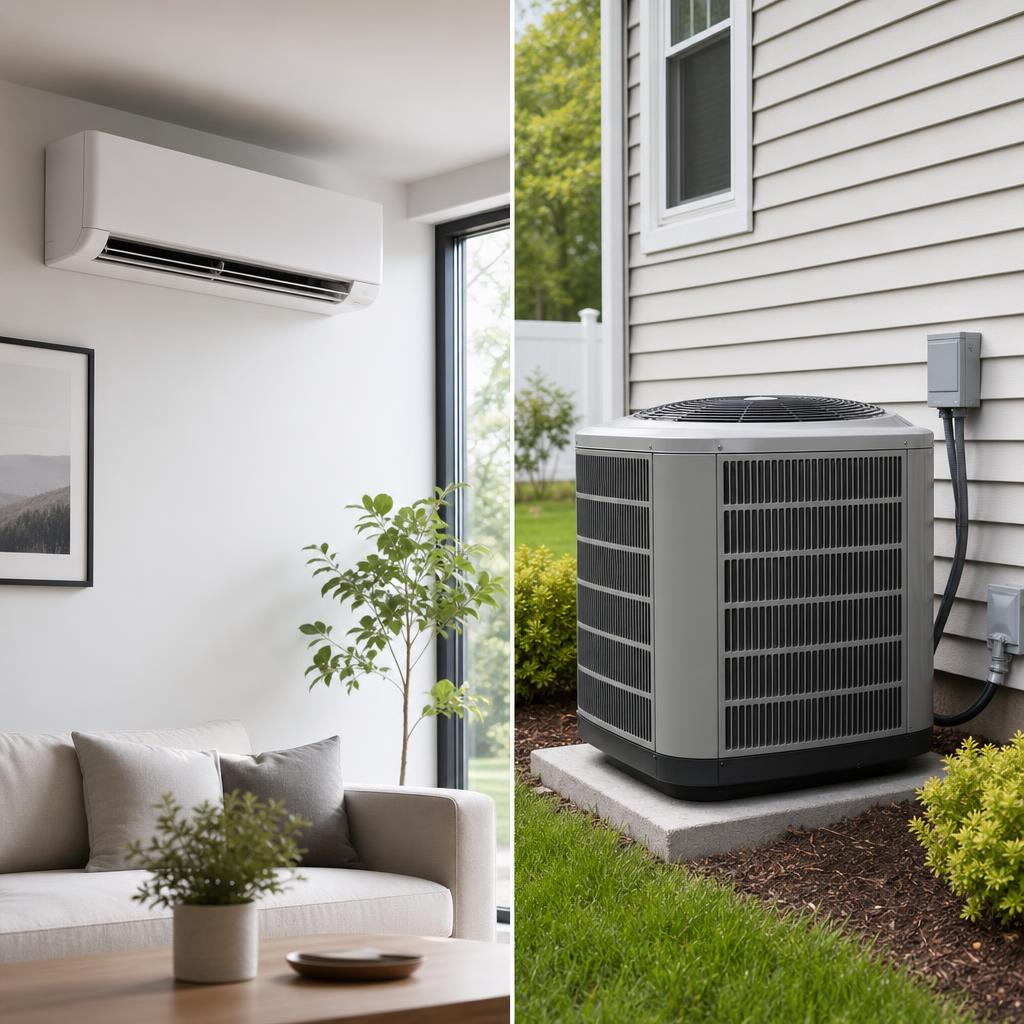
Most people end up here because the ductwork situation is complicated. Either they're adding a room where a new duct run doesn't make sense, or they have an older home with no existing ductwork at all. Sometimes it's simpler: a contractor mentioned mini-splits during a replacement quote and you want to know whether the efficiency premium is actually worth paying.
Neither system is categorically better. The right choice depends on what you already have, how many zones you need, and what ductwork actually costs in your situation.
Quick answer
Mini-splits win for room additions, older homes without existing ducts, and detached structures. They're especially worth pricing when you need both heating and cooling from a single unit. Central air wins for whole-house cooling in homes that already have good ductwork, new construction, and anywhere resale simplicity matters. If you're adding ductwork from scratch, run the numbers both ways before committing.
How Each System Works
Central air moves cooled air through a network of ducts and registers. One outdoor condenser cools refrigerant, sends it to an indoor air handler, and a blower distributes conditioned air through the house. Every room gets its air from the same system, controlled by one thermostat.
Mini-splits skip the ductwork entirely. Refrigerant runs directly from a compact outdoor unit to one or more wall-mounted indoor heads, each with its own controls. No shared ducts means no shared duct losses, and duct losses are a bigger deal than most people realize.
Repair or replace?
Compare free quotes from licensed contractors near you.
What Each System Costs
These are 2025 to 2026 installed-cost national averages. Local labor rates move the numbers considerably in either direction.
| System | Typical Installed Cost | Notes |
|---|---|---|
| Mini-split, single zone | $3,000 to $5,500 | One outdoor unit, one indoor head; covers 400 to 800 sq ft |
| Mini-split, multi-zone (3 to 4 heads) | $8,000 to $16,000 | One outdoor unit, independent control in each room |
| Central AC, existing ductwork | $4,500 to $12,000 | 3-ton system; assumes ducts are in place and serviceable |
| Central AC, new ductwork required | $8,000 to $19,000 | Retrofit ductwork adds $3,000 to $7,000+ depending on home size and access |
The ductwork row is where most comparisons go wrong. If your home has well-maintained existing ductwork, central air almost always wins on installed cost. When you're adding ductwork in an existing home, the gap closes fast. In older homes without any existing ductwork, a multi-zone mini-split often comes in at the same price or cheaper than central air plus the duct installation.
Where Mini-Splits Win
Room additions are the clearest case. Extending a duct run from an existing air handler to a new 400-square-foot addition typically costs $2,000 to $4,000 in labor alone, and the extra load often strains the existing system. A single-zone mini-split in that space costs about the same or less, and conditions only that space without touching anything else.
Other situations where mini-splits have a clear advantage:
- Detached garages, workshops, and home offices where running refrigerant lines is far simpler than duct runs
- Historic homes where cutting through original plaster or finished ceilings would cause damage
- Converted basements and attic spaces that the main ductwork can't reach effectively
- Problem zones that consistently run too hot or too cold regardless of how many registers you open or close
Mini-splits also solve the single-thermostat problem. If people in the same house have meaningfully different temperature preferences, each zone can run independently. That's something central air with one thermostat never fully addresses.
Where Central Air Wins
In homes already built around forced air, central air is the simpler choice. One outdoor unit, one air handler, one thermostat, one annual tune-up. That simplicity has real value, especially if you'd rather not manage multiple systems or learn a new interface.
New construction strongly favors central air for whole-house cooling. Duct installation during a build costs roughly $4 to $8 per linear foot versus $15 to $25 for retrofit ductwork in an existing home. The cost advantage that makes mini-splits attractive in older homes disappears when ducts go in before the drywall does.
Resale is a genuine factor too. Most buyers in most U.S. markets expect central air. A home with wall-mounted mini-split heads in every room instead of a traditional system will prompt questions, and some buyers simply won't want to deal with an unfamiliar setup. This is changing as mini-splits become more common, but for a home you plan to sell in the next few years, central air is still the path of least resistance.
The Efficiency Gap
Mini-splits are meaningfully more efficient than central air, and the gap is larger than the SEER2 ratings alone suggest.
| System Type | Typical SEER2 Range | Duct Loss Factor |
|---|---|---|
| Central AC (standard) | SEER2 14 to 18 | 20 to 30% of conditioned air lost to duct leakage and heat transfer |
| Central AC (high efficiency) | SEER2 18 to 22 | 20 to 30% duct loss still applies |
| Mini-split (standard) | SEER2 18 to 24 | Negligible; refrigerant delivered directly to the room |
| Mini-split (high efficiency) | SEER2 24 to 33+ | Negligible |
The gap starts with the compressor. Mini-splits use inverter compressors that modulate output continuously rather than cycling fully on and off. A standard central system runs at 100% capacity until the thermostat is satisfied and then cuts out entirely. That constant cycling wastes energy.
The bigger factor is duct loss. The U.S. Department of Energy estimates that 20 to 30 percent of conditioned air is lost through leaks and heat transfer in typical duct systems. A mini-split delivering refrigerant directly to the room it's conditioning loses almost none of that. On a home spending $1,200 per year on cooling, the difference can amount to $300 to $450 annually in operating savings.
Repair or replace?
Compare free quotes from licensed contractors near you.
Can a Multi-Zone Mini-Split Replace Central Air?
A multi-zone system runs 2 to 8 indoor heads from a single outdoor unit, each zone operating independently. For a home being extensively renovated or built from scratch, a multi-zone mini-split can fully replace central air and usually costs less to run over time.
The friction point is aesthetic. Wall-mounted indoor heads are visible in every room. In a modern or minimalist space they look at home. In rooms with traditional trim and furnishings, they can feel out of place. Some homeowners adapt easily; others find it bothers them more than expected. Worth thinking about before committing, because moving a mini-split head after installation is not a small job.
Comfort is actually a strength. Each zone responds quickly and holds its temperature precisely. A bedroom set to 68 doesn't get overcooled just because the living room is still warming up.
Heat Pump Mini-Splits and the IRA Tax Credit
Most mini-splits are heat pumps. They heat in winter by running the refrigerant cycle in reverse, and modern cold-climate models work effectively down to -13°F or below. For a home in a region with real winters, you're getting both an air conditioner and a primary heating source in one installed unit.
A qualifying heat pump mini-split earns a 30% IRA federal tax credit capped at $2,000 per year, compared to $600 for a qualifying central AC. On a single-zone mini-split with an installed cost of $4,000 to $5,500, that $2,000 credit is a significant portion of the total. Multi-zone systems with higher installed costs also qualify. The credit resets each calendar year, so larger multi-zone installs spread across two tax years may be worth planning around.
What Maintenance Looks Like
Both systems need annual refrigerant checks and coil cleaning by a technician. The day-to-day difference is filter maintenance.
Mini-split filters are user-washable mesh screens inside each indoor head. They should be rinsed monthly. Neglecting them is the most common cause of reduced performance, and unlike a clogged central air filter that's hidden in a closet, a dirty mini-split filter shows its effects quickly. Central air filters run $10 to $30 and need replacing every 1 to 3 months depending on filter thickness and household conditions.
Central systems may also need duct cleaning every 5 to 10 years, which typically runs $300 to $600 for a full house. Mini-splits never need duct cleaning because there are no ducts.
Questions to Run Through Before Deciding
Most of the time, one or two of these questions settle the decision:
- Does your home have existing ductwork in good condition? If yes, central air is almost certainly the right choice for whole-house cooling unless you're adding zones the ducts can't reach.
- Are you cooling the whole house or one or two specific zones? Specific zones almost always go mini-split.
- Is new ductwork required? If so, price both options. The cost gap between central-plus-ducts and a multi-zone mini-split is often smaller than expected.
- Do you also need heating? Heat pump mini-splits cover both. If the answer is yes and you're replacing heating and cooling together, the IRA credit math changes considerably.
- Are you selling the home in the next five years? Central air is the safer choice for resale in most markets.
Choosing Brands
For mini-splits, brands with strong U.S. service networks include Mitsubishi Electric, Daikin, Fujitsu, LG, and Bosch. Mitsubishi and Daikin tend to lead on cold-climate performance and inverter efficiency. For central air, familiar names include Carrier, Trane, Lennox, Goodman, and Rheem. Either way, use our HVAC age checker to verify the manufacture date on any unit you're being sold as new or lightly used.
The Bottom Line
Homes with good existing ductwork should almost always stay with central air for whole-house cooling. The efficiency advantage of mini-splits doesn't outweigh the cost of replacing a functional system before it fails. Where the case for mini-splits gets compelling is anywhere ductwork is expensive, impossible, or doesn't exist.
For additions, older homes, and detached structures, mini-splits almost always win on cost, efficiency, and installation ease. The case gets stronger still when you need both heating and cooling from the same unit. Before committing to either system, get bids on both. Ask the contractor to break out the ductwork cost as its own line item. That number often shifts the comparison more than anything else.